Flight to Dubai, over 8 hours, was uneventful emerged from plane into 80- plus humid heat, though it was not yet 6 AM. Very large and modern airport.
Driven to our luxurious hotel, Al Qasr, approached through a tree-lined avenue of sculpted, golden Arabian horses. Hotel has an Oberoi feel to it, but not themed as many Oberois seem to be. We are exhausted and, as we're not to be picked up until 3 PM, we pass on taking advantage of the many hotel amenities, including transportation via waterways, in favor of going to our large, ocean-view room to sleep. We give our dirty clothes to the laundry, though it might have been as cost effective to throw them out and buy new clothes. We are definitely not in Kansas, or Ghana, any more.
At 3, we're picked up by our absolutely delightful guide, Leah Gulen. She is from the former Yugoslavia, and moved to Dubai about ten years ago, with her husband and two sons. In addition to perfect English, she speaks Italian, French and Spanish.
Leah is a very enthusiastic supporter of Dubai, but open and honest in her responses to our questions. The overwhelming sense one gets is of what oil money can build in a very short period of time. Fifty years ago, perhaps a bit more, Dubai was desert.
Dubai is one of seven Emirates, each headed by a sheik. The United Arab Emirates were formed in 1971, when the area emerged from a British protectorate. While the population of Dubai is 1.8 million, only about 20% are local, the rest foreign nationals, which contributes to it's more open and relatively, only relatively, less conservative nature. The other well-known Emirate, Abu Dhabi, is considerably more conservative.
Marriages are still arranged, though girls can now sometimes say, "no," and husbands are supposed to support four wives. While this is still rather alien to Leah's thinking, she gives the positive side of it, too (support). Everyone (except spouses) is required to hold a job, so that there won't be poverty, and loss of a job entails quick deportation. Homosexuality is not condoned or recognized, though it exists.
Our 4-hour tour is a whirlwind. We see many of Dubai's highlights, the boat-shaped, seven star hotel with helipad and all duplex suites, Burj Al Arab, which would have cost an extra $600 to stay one night at and the tallest building in the world at 120 stories, designed by Chicago architect, Adrian Smith.
We spend quite a bit of time at the Dubai Museum, in the Al Fahidi Fort, which gives one a good sense of the development of Dubai. We take a water taxi across the Dubai Creek and wander through the gold market, bathed in heat and humidity. We feign interest in some gold jewelry in order to get an air conditioned respite from the heat.
Leah drops us off, too early, for our 3-hour dinner cruise on the Dubai Creek in a very nice air conditioned boat, with guitar and piano music. The cruise is pleasant and the dinner good, though the poor map we are given makes locating what we are passing pretty-near impossible.
Our limo is 15 minutes late picking us up, which does not please us, as we need to arise at four in the morning. Back at the hotel, we get packed and set for early departure.
Though we only skimmed the surface, I think we got some sense of Dubai, and so the stop-over was worth doing. Not a spot we're likely to return to.
We're in the Accra airport, having had a very full and atypical-of-the-rest-of-our-trip day. Today, we were tourists.
Prior to setting out for the airport, we managed to find and stop at the Arts Alliance Gallery that Dick Kiphart had mentioned was being promoted by Kofi Anan. It was excellent and very reasonably priced, with a wide range of appealing art work. Unfortunately, as we were not going home, and the cost of shipping for one item we liked was $800, or twice the cost of the item itself, we escaped unscathed. Not so for the craft market we visited earlier, though, a sort of "cachki" heaven, where we (Carol, with her embarrassing successful bargaining) loaded up with gifts.
After breakfast at the hotel, we set out with Peter, Freedom, Jonathan and Joseph, considerably more support than we needed. First stops were casket shops, where wooden caskets were carved in forms that reflected the professions, avocations or status of the deceased--fish, crabs, cameras, roosters, etc. Fun to see. We stopped back later in the day to pick up an item we'd passed on earlier.
From there we went to the old fishing village of Jamestown, where the beachfront was in full activity, with fishermen, sellers of fish, net menders, etc, all doing their stuff in the rather dirty, fishy-smelling village. Unlike elsewhere we'd been in Ghana, many people (women, especially) were not eager to have their pictures taken. A light house and castle sit above the beachfront, the latter being part of the slave trade.
After Jamestown, we went to the large craft market, with rows of stalls and sellers peddling all kinds of crafts. While the vendors were friendly and forward, they were not offensively pushy as we've found in similar situations elsewhere in the world.
We stopped with full entourage at a bar/pub/restaurant that had a soccer game and the Commonwealth Games on TVs. Service was rather slow, and Carol did not get what she ordered, but the rest of us all had a good lunch.
The ride to the airport from the restaurant was short, and our transition through the various airport stages remarkably quick and smooth. We said our good-byes to Peter, Freedom, Jonathan and Joseph and thanked and tipped them for their attentiveness and service throughout our trip. One of my cards got us into an airline lounge with food and wifi, which is where I'm typing this, awaiting our eight-plus hour flight to Dubai on Emirates Airline.
We set out after breakfast for what turned out to be a 3- hour drive to Mansokwaa, probably the most remote of the villages we visited. As we passed through towns and by roadside stands, I prevailed on our driver to stop from time to time so that I could try to capture something of the flavor of what we'd seen each day.

When we reached the village, we were ushered into what was supposed to be a junior high building built by the Kipharts, but in fact was being used for K through 6. Some 120 adorable kids were seated in wooden desks that had been stamped "Donated by the Kiphart family.". The obligatory round of speeches included many requests for additional help and the surprise information that the young high school graduates who served as teachers in this remote area had not been paid anything by the government for a year. Peter promised to intervene and the Kipharts, very upset at this information, said that they would guarantee payment of the salaries if the government failed to pay them, despite their policy against paying for operating expenses. In his speech, Peter exhorted students, teachers, parents and the assembled school committee, each to do their parts.

After presentation of gifts to the school and a brief tour of the facilities, we all donned long, black Wellingtons and trudged through the brush to visit two even more remote villages. The weather was quite hot as we walked through the brush, seeing the cocoa plants, plantains and cassava, so, by the end we were very sweaty and a bit weary.
We drove a couple more hours, most of which on relatively good roads into Accra, the capital. We stopped at Peter's house, and met his wife and a couple daughters. After a cold drink, we drove to the restaurant at which Peter had made reservations, accompanied by large parts of Peter's family and a few others who we had not met before. Still sweaty and hot from the long day, this was a bit more togetherness (perhaps a lot more) than I would have opted for, given a choice. Still, the buffet dinner was fine, and the cold Star beers most welcome.
We drove to our hotel, the Golden Tulip, in what easily was the worst drive of the trip. Traffic was horrendous and the pollution caused by the cars most unpleasant, especially with rolled down windows. More than an hour and a half later, we reached our hotel and bade farewell to the Kipharts and Margot. Although I have not mentioned her much in this blog, Margot was a delightful travel companion and good sport throughout.
Peter said he'd pick Carol and me up at 10 the next morning, but I said, no, we had a lot to see. He agreed to come at 8, but I'm betting on 9.
We managed to get on the internet, finally, and I think I successfully downloaded all of the previous days' descriptions. I also downloaded some pictures to my iPad. I have not included any photos in the blog, but may try to figure out how to do that in the coming days.
The hotel is quite fine. After a delightful warm shower, I called it a day.
Set out after breakfast, at which we were joined by a woman from San Francisco and her college-aged daughter.
Long ride through familiar roadside stands and villages, at one point encountering a long funeral procession of young people dressed in black, with a couple bands marching amidst them. This is one of quite a few photo opportunities that I would have explored, except that they did not fit into the main purpose of the trip and might have cut short or eliminated things that were on the schedule.
After about four hours, we entered Cape Coast, were met by Joe and Ida, and proceeded to drive by the Elmina harbor and castle and then on to Cape Coast Castle and the slave museum on the site where many involuntary immigrants were shpiped to the New World in a slave trade that flourished for more than two centuries under the Portuguese, Dutch and English. President and Mrs. Obama visited the castle in July, 2009, and one can only imagine the impact of such a visit on an African-American person.
We were guided through the dungeons where slaves were house, often for a couple months, before being shipped off, manacled, in inhumane and crowded conditions on the several-month voyage to slavery in the New World. We were also shown the courtyard in which they were branded for identification. The slaves were prisoners captured by one black tribe in combat against another, then sold to Europeans as slaves at the coast, evidence of the dehumanization and horrors of war.
From the castle, we drove to Cape Deaf, the school for deaf children in Cape Coast. There we witnessed an amazing dance performance by deaf children who kept in time through feeling the vibrations from the loud drums, played by blind students. Afterwards, we toured the school farm created through Joe and Ida's NGO, with children clamoring for our attention, holding our hands, trying to communicate with us through sign language and indistinguishable sounds. One is struck by the gross unfairness of children being saddled with such a disability through no action of their own, other than being born. It was a very moving experience and a vivid reminder of what charmed lives we live. The Kipharts have supported the school through Joe and Ida's NGO.

From the school--hot, dirty and tired--we proceeded to a restaurant some miles down the way on the beach. As we were driving there, I was wishing that we'd opted to have a more relaxing dinner at the hotel. In fact, though, the dinner was excellent and afforded the opportunity for more talk with Joe and Ida. Returned to the very nice Elmina Beach Resort to shower and go to sleep, after what's become a ritual of downloading a few photos from the day and writing in what will become my blog, if and when we get internet connection on my iPad.
Joined for breakfast at the hotel by Annie, who presents me with a beaded chief's bracelet to wear. I raised several questions with the Kipharts that were churned out in the early morning hours by my consultant's brain. They seemed glad I'd raised them, though many were issues they'd already been wrestling with.
After, set off for traffic-filled drive over paved road, then increasingly difficult, deeply pot-holed dirt roads. On the paved roads, we pass a more-or-less constant line of vendors and small roadside stores, all appearing to sell very similar merchandise, what Dick refers to as an over-distributed economy.
We are in very rural Ghana, completely off the tourist track, led by Peter, who is the Kipharts trusted friend and key person and who has been with us throughout, planning, revising, monitoring and supervising our trip.
We are headed first for Bonkwaso II and the school that the Kipharts built there. As in other places, after the Kipharts built a school, the government stepped in and built another. We are "treated to" a very long ceremony, with lines and handshaking. Several chiefs are present, including one who is a weaver and presents us with gifts, and a high, area chief.
The ceremony has elements that we have not seen before, including poetry recitals by young children (very cute) and a rather long darma acted out by the children. These are followed by the obligatory round of speeches and the ribbon-cutting to dedicate the school. Everywhere, genuine gratitude is coupled with a request for more help, another school room, a roof, a toilet, etc. Seeing schools and wells in these remote, inaccessible villages, it is easy to understand how the generosity of the Kipharts could be understood as evidence of Divine intervention. Chiefs say, "I never dreamed we would have something like this."
We distribute gifts that Margot and we had brought. Dick and I demonstrate how to play frisbee. Afterwards, I conduct a rather brief interview with one of the chiefs, before we set out, greatly behind schedule, as usual.
 Dirt roads lead us to the next village, a river town that was almost flooded the last time the Kipharts visited, due to a bridge built by the government, which created a dam in the river. The young- looking chief (or nana, as chiefs are called) is a Kiphart favorite, as he seems to be a doer. We walked through the poor, but relatively clean, village and down by the river to see the bridge. After distributing more gifts, we are invited to participate in a meal they've provided, but most of us are too worn by the heat to be hungry.
We set off down more dirt country roads, passing small villages with churches or mosques, to arrive at St. Ann, the clinic established and run by a midwife for the past twenty-five years. She is a devoted servant, delivering probably 120 babies a year, never having lost a mother. She seems to have delivered most of the children (and now adults) in the area.
Her clinic is very modest, but functional, and she is very grateful for the support the Kipharts have provided and rather reticent to ask for more, though Dr. Annie, who is quite taken by Anna, seems to be assuming the role of coach to tell Anna what else she should be asking for.
Anna has prepared food for us, too, which fortunately our drivers, Freedom and Jonathan (and another fellow, Joe), partake of. We distribute some gifts, then set out in the dark for the long, often bumpy, trip back. We arrive after seven, prepare very quickly for dinner and have a quite good meal, prepared by Charity, accompanied by large bottles of cold One Star beer, which has become a big favorite, and retire.
We are seeing a country in a way different from the way we've seen any in the past, and it's proved most interesting and rewarding.
Set off after breakfast, through terrible Kumasi traffic, to drop Margot at Dr. Annie's clinic to spend the day. We were to go on and return to the clinic by 1 PM. Late dropping her off and heavy traffic got us to the village of Krapa far behind schedule.
At Krapa, the Kiphart's school was augmented by a school farming project run by an NGO established by the head of the Agricultural School, a Ghanaian named Joe and his Lebanese/American and Iranian-born wife, Ida, who met one another at Ohio State University. We spent considerable time in the fields seeing and hearing about the agricultural development spear-headed by two agriculture students and helped by the students in the Krapa school. The farming also included 400 newly-born chicks. Great progress had been made since the Kiphart's last visit, both in the field and in completing the school building.

I had brought 15 cameras from Evanston, which I distributed to the "chosen" students, after they had recited a pledge to Susie. The original plan, for the pictures to be taken and developed while I was here was unrealistic, so follow-up was left in the hands of teachers and Dr. Addai, who gave a rather scary introduction to the children. I intervened with a much softer description, in which I emphasized that the project should primarily be fun for them.
Unfortunately, I did not have time to do interviews with either the local chief or the 80-plus year old higher chief, who had known Kwame Nkruma, Ghana's first president. Susie and Carol had left for the clinic with Peter. Dick and I were driven by Joe and Ida, once I'd finished with the camera explanation. This gave me time to learn about their interesting background and about agriculture in Ghana, and to record that interview.
We arrived at the clinic after the day's bustle had subsided, which was too bad. We did get a full tour of the miraculously-reconstructed (confirmed by Susie and Dick, who were tremendously impressed and surprised with the outcome of the work they'd financed) maternity facility and then the rest of the children's clinic run by Annie.
We wound up in Annie's office, where she explained with great enthusiasm the work she was doing, including work with orphans and prisoners that she'd added on her own. She told, with the help of Peter's architect/son, Alex, of what she still needed, most of which will almost certainly be provided by the Kipharts.
After our meeting, the Kipharts, Margot and we went to the huge, crowded and teeming market near the clinic, one of the largest markets in West Africa. Led by Jonathan, we moved swiftly through the narrow, bustling streets and soon it began to rain. We turned around and headed back to the car, the rain-drenching being rather pleasantly cooling. While it would have been nice to experience the market under lass rushed and drier circumstances, and to have the chance to photograph it, we at least got a taste of the colorful spectacle.
We drove back to the hotel, managed to check the Internet very slowly and dried and washed up, prior to being picked up for a short ride to a nearby hotel for what turned out to be a larger than expected (over 30) gathering of well diggers, contractors, architects, doctors, chiefs, prophets and assorted other friends of the Kipharts. Everyone introduced himself and told what they were up to, heaping uniform, lavish and deserved praise on the Kipharts for their efforts and support. It was a wonderful tribute that they received humbly and in which we were privileged to participate. Their deep involvement and dedication is apparent at every turn. At the end, the prophet, who was something of a surprise guest, blessed everyone in language I could not understand. It turns out (we discovered the next day from Peter), that nobody else could understand him either, since he was speaking in tongues.
I was encourage by Dick to show the photos I'd downloaded to my iPad, which were enjoyed greatly by prophet, chief, dean and lesser beings.
Back to the hotel, after another most full and interesting day.
Breakfast at the hotel, then set off for our first visit of the day, turning off the highway down the bumpy dirt roads of rural Ghana to the village of Emanuel, named for the 92-year old prophet, Emanuel.
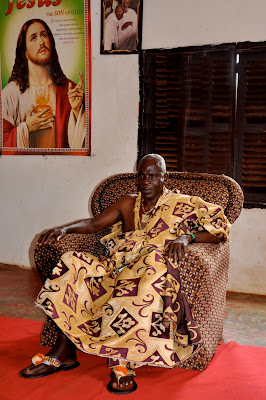 On arrival, we're ushered into a room dominated by the chief, a major chief, sort of the vice-president of chiefs for the Ashanti area, dressed in regal-looking garb, and flanked on the nearby couch by Emanuel, dressed in a green and yellow printed cloth, and two other elders of the village. After we explained our "mission," the first step in every meeting, we were greeted warmly. Greetings consist of those present forming a line and walking by to shake each of our hands in welcome or thanks. Textile gifts were given to all of us.

After the two-hour ceremony, we set off in the van for our next village, munching on a lunch of power bars and trail mix. We arrived at the village of Boatenkrom, where after a very brief, at least by comparison, ceremony, we met with and interviewed the chief, a very mild-mannered fellow in a suit and tie whose day job was teaching English in a village a few kilometers away. We were unable to unearth any real stories of interest, but did learn some of the history of the village. After looking at the Kiphart school and seeing another group of adorable kids, we headed down to see the well that the Kipharts had given, which was working perfectly. Alex, the Kiphart's trusted construction contractor, accompanied us.
We set out for our third and final village of the day, Afraku in a light rain, where the Kipharts had donated another school and well.
After a brief greeting Carol and I interviewed a chief, through a translator. Unlike the school teacher chief, this one was dressed in traditional garb of black and white and told of the history of the village and the role of the spirits in that history. Though he's a Christian, the chief pours libations to the spirits every Tuesday. The secrets and secret history of the village is told only to inner family members. I told the chief that I would return next year as his son to learn some secrets.
By now, it was close to 5 PM, and we drove home in the rain and had a very short few minutes before dinner. The dinner group was the same as the previous night, except that Annie 's daughter did not join us.
I jokingly asked Dr, Addai whether he'd seen any prophets that day, and he proceeded to tell a very long and bizarre story about the recent near-death experience he'd had caused by a sudden stomach tumor visited on him and cured by the grace of God through the prophet Ebenezer, with whom he'd visited that day. There ensued a very interesting discussion about demons and other religious beliefs. Annie, arriving late, missed this discussion, but came in like a tornado, and the discussion turned to the medical problems she sees most frequently in her clinic, from malaria to diarrhea. We will visit her clinic tomorrow, which we are all looking forward to.
After dinner, comprised primarily of large, heavy, chewy dumplings called fufu, composed of cassava and plantains, served in a broth of peanut liquid (quite good, but very heavy), the guests left and we talked in the living room for some time with Margot, Dick and Susie, before retiring at the end of a long, but very interesting day.


